
Truth & Healing
Observations and Learnings
Relationships
Multi-year Support


By using our traditional stories and teachings to provide a strong and stable language development foundation, Saad K’idilyé has been able to open a pre-K program that teaches in the language rather than about the language. In doing so, Saad K’idilyé plays a critical role in the revitalization and continued living use of the Diné language.
Seed Investment: Honoring Traditional Roles
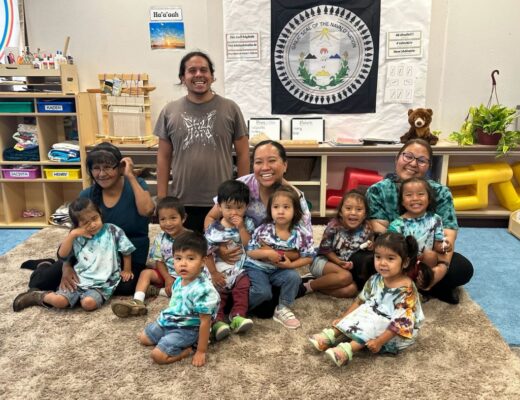
At the heart of our work is the Saad K’idilyé Caretaker Language Apprentice Program, built on the understanding that caretakers must grow into fluent speakers and eventually become teachers grounded in language and love. These homegrown teachers create a living teacher stream reflecting traditional Diné relationships between caretakers, teachers, and youth.
Better Way’s early Responsible Entry investment helped bring this program to life. Through the Saad Nizhonigo Bee Ya’ati’ Bohoosh’aah program, second-language learners receive immersive training, mentorship, and classroom experience—up to 1,800 hours of Diné immersion—while supporting children in caregiving roles.
For us, that integration matters. It is deeply Indigenous.
Learning is reciprocal: Caretakers develop language as children learn from them.

Truth & Healing
Many caretakers did not learn Diné as children. We acknowledge that history but focus on rebuilding pathways for language to move between generations, relationally and naturally. Language revitalization is also healing.
Better Way’s support reflected this understanding. Funding did not dictate the program but supported what the community was already building—paying fluent speakers, supporting second-language learners, and creating opportunities for parents. Parents now participate in 100 hours of language classes, fostering intergenerational learning. Three second-language learners have been certified by the Navajo Nation to teach Diné.

Saad K’idilyé translates to “The Planting of the Language Seed” and it is the first Diné language nest immersion program that addresses Diné language and cultural revitalization and sustainability.


Observations and Learnings
Our work informs research. Through the Nihíyázhí Bizaad project with the University of New Mexico, we track Diné language development in infants and toddlers. The study asks: How do Diné children begin to learn? How much input is needed for the language to take root? Research listens and evolves with the work, not extract from it.
That same spirit of listening shapes our classrooms.
We adjusted our program when enrollment exceeded what our immersion environment could support, limiting participants to prenatal through three months after birth to maintain immersion quality. Operationally, we strengthened consistency—addressing attendance, introducing modest tuition, and having families sign recommitment letters. These measures were embraced and kept us aligned with our mission: Raising first-language speakers of Diné.
One parent captured the deeper impact: She remembered adults speaking Diné when she was a child so kids wouldn’t understand gossip. Recently, she heard her son doing the same with his grandmother. Language is moving naturally between generations—through humor, storytelling, and connection. By 30 months, children form two- to four-word sentences and engage in conversation.
With 7,500–9,000 hours of immersion in the first five to six years, this language nest is producing what I never achieved as a classroom teacher: First-language Diné speakers.



Relationships & Constellations of Support
Saad K’idilyé grew from relationships.
I developed the model through the School Design Fellowship with the NACA Inspired Schools Network. Many of our Indigenous early childhood partners connect through that network. Better Way first learned of our work via NISN, opening possibilities for infant– and toddler-family immersion.
Since then, the circle of support around Saad K’idilyé has continued to grow.
Partnerships with the University of New Mexico, Albuquerque Public Schools, the Changing Woman Initiative, and others anchor our work in cultural integrity, community relationships, and educational rigor.


A Widening Circle
Better Way’s seed investment was deliberate, relational, and patient. Today, we cultivate not just language fluency but belonging. Children hear their language daily. Caretakers are becoming teachers. Parents reclaim words alongside their children.
Multi-year support through Better Way’s Strategic Growth partnership gives stability to deepen this work and expand access to culturally grounded early childhood education. In 2026, Better Way partnered with the W.K. Kellogg Foundation to host a funder dinner in Santa Fe, gathering 30 funders and leaders to learn about our language nest. The setting—a cozy Airbnb with a meal by Taos chef Johnny Ortiz—reflects what it means to be a good partner: Supporting directly while inviting others into the circle.
Seed by seed, the work is taking root. Children are speaking. Families are healing. Language is returning to everyday life. The language nest continues to grow.